Guide to Israeli Currency Unit Solutions: Mastering the New Israeli Shekel
Venturing into Israel, whether for tourism, business, or simply out of curiosity, inevitably brings you face-to-face with its unique monetary system. Understanding the local currency is not just about making transactions; it's about navigating daily life, budgeting effectively, and even appreciating a piece of the nation's history and culture. For those seeking clarity on the Israelische Münzeinheit, this comprehensive guide offers practical solutions and insights into the New Israeli Shekel (NIS), its history, denominations, and practical usage.
From recognizing genuine banknotes to efficiently managing your finances during your stay, we'll equip you with all the knowledge you need. Even if your interest stems from solving a challenging crossword puzzle clue related to the "Israelische Münzeinheit," this article aims to be your definitive resource.
The New Israeli Shekel: A Glimpse into its History and Present
The current monetary unit of Israel is the New Israeli Shekel, often abbreviated as NIS or represented by its currency code ILS. It's a relatively modern currency, a testament to Israel's dynamic economic journey.
From Lira to Shekel: A Brief Historical Overview
Israel's currency has undergone several significant transformations since the nation's founding. Initially, after gaining independence in 1948, the currency was the Israeli Lira (ILR), which replaced the Palestinian Pound. However, galloping inflation in the late 1970s and early 1980s necessitated a drastic change. In 1980, the Israeli Shekel (ILS) was introduced, with 1 Shekel replacing 10 Israeli Lirot. Yet, this "Old Shekel" also quickly succumbed to hyperinflation.
The solution came in 1985 with the introduction of the New Israeli Shekel (NIS), or simply "Shekel" in common parlance. This new currency was introduced at a rate of 1 New Shekel for 1,000 Old Shekels, as part of a successful economic stabilization plan. This pivotal moment cemented the NIS as a stable and globally recognized currency, symbolizing Israel's economic resilience and growth.
Understanding the Denominations: Coins and Banknotes
The New Israeli Shekel is subdivided into 100 agorot (singular: agora). Both coins and banknotes feature prominent Israeli figures, landmarks, and symbols, offering a miniature cultural tour with every transaction.
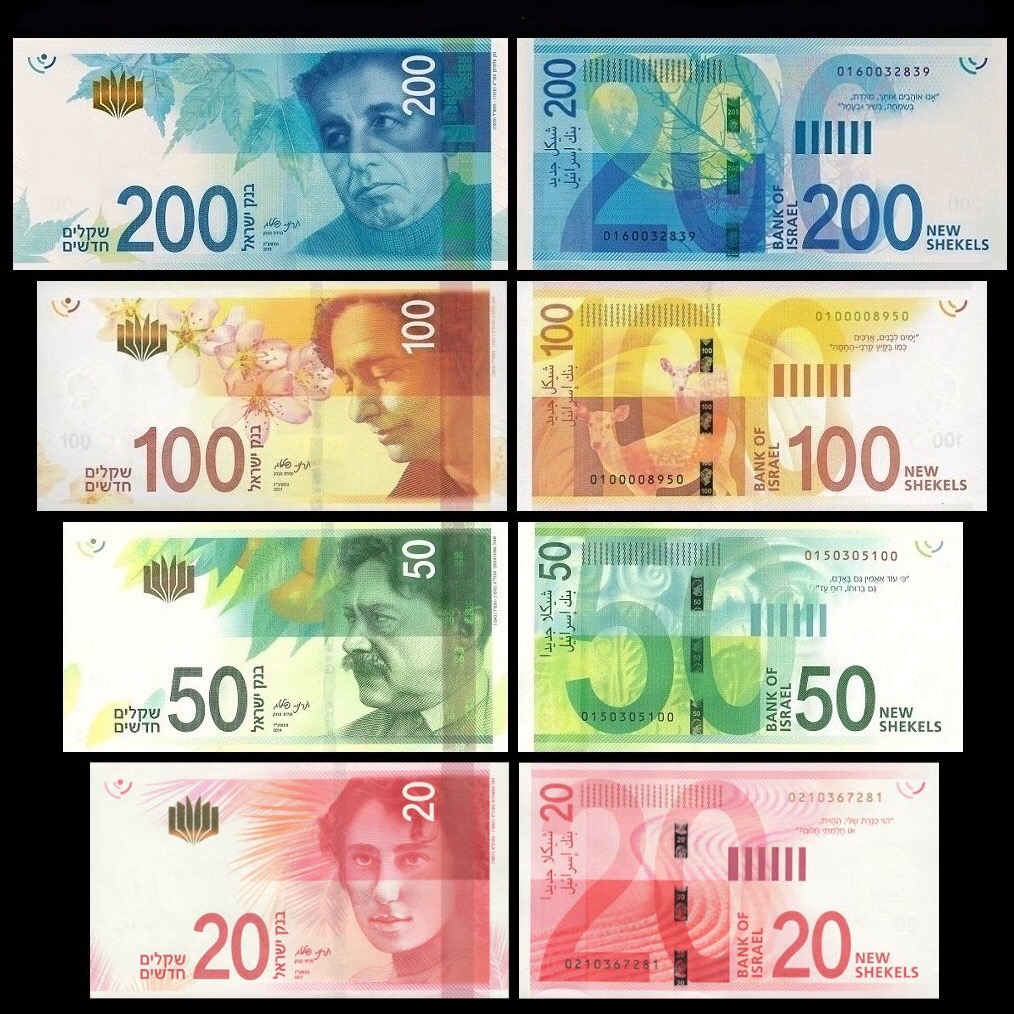
Current Banknotes:
- 20 NIS: Features Rachel the Poetess (Rachel Bluwstein) on the front, and a palm tree on the reverse. Predominantly red.
- 50 NIS: Depicts Saul Tchernichovsky, a prominent Hebrew poet, with citrus fruits and their leaves on the reverse. Predominantly green.
- 100 NIS: Showcases Leah Goldberg, a renowned poet, author, and literary researcher, with a cluster of deer and flowers on the reverse. Predominantly orange.
- 200 NIS: Features Nathan Alterman, a leading figure in Hebrew poetry, with an autumn forest and falling leaves on the reverse. Predominantly blue.
These banknotes are part of the "Series C" (also known as the "Third Series of the New Shekel"), introduced between 2014 and 2017, and boast advanced security features to combat counterfeiting.
Current Coins:
Israeli coins are known for their durability and clear designs:
- 10 Agorot: Features a menorah with the state emblem.
- ½ Shekel (50 Agorot): Depicts a lyre, reminiscent of King David's instrument.
- 1 Shekel: Features a lily.
- 2 Shekels: Depicts two cornucopias, symbolizing abundance.
- 5 Shekels: Features the capital of a Roman column.
- 10 Shekels: Depicts a palm tree, a common motif in ancient Judean coinage.
It's important to note that the 1 agora and 5 agorot coins are no longer in circulation, though prices may still be quoted in fractions that theoretically would require them; in practice, amounts are rounded to the nearest 10 agorot.
Practical Solutions for Managing Your Israelische Münzeinheit
Whether you're visiting for a week or planning an extended stay, efficiently managing your Israelische Münzeinheit is crucial for a stress-free experience.
Currency Exchange and Banking Tips
- Where to Exchange: While airport exchange bureaus are convenient, their rates are often less favorable. Better rates can typically be found at licensed exchange offices in city centers, banks, or post offices. Always compare rates and inquire about commissions before exchanging.
- Using ATMs: ATMs are widely available throughout Israel, especially in urban areas and tourist hotspots. They offer a convenient way to withdraw NIS directly from your foreign bank account. Be aware of potential transaction fees from both your bank and the local ATM operator. Inform your bank of your travel plans beforehand to avoid any security holds on your card.
- Credit/Debit Cards: Major credit cards (Visa, MasterCard, American Express) are widely accepted in hotels, restaurants, shops, and larger establishments. It's always wise to carry some cash for smaller purchases, street vendors, or in less urbanized areas. Opt to pay in NIS if given the option, as dynamic currency conversion (DCC) often results in less favorable exchange rates.
- Budgeting: Israel can be an expensive country, particularly for accommodation and dining in major cities like Tel Aviv and Jerusalem. Factor this into your budget. A typical meal can range from 50-100 NIS, while a simple coffee might be 10-15 NIS.
Current Exchange Rate Dynamics
The value of the New Israeli Shekel against major world currencies (like USD, EUR, GBP) fluctuates based on global economic factors, local interest rates, political stability, and market sentiment. You can easily check current exchange rates using online currency converters or financial news websites. It's a good practice to monitor these rates if you plan to make large exchanges or if your trip coincides with significant economic news.
Security Features and Identifying Authentic Israeli Currency
Like all modern currencies, the New Israeli Shekel incorporates advanced security features to deter counterfeiting. Knowing what to look for can give you confidence in your transactions.
Protecting Against Counterfeit: What to Look For
The "Series C" banknotes are designed with multiple overt and covert security elements:
- Watermark: Holding the banknote up to light reveals the portrait of the figure on the bill and a tiny denomination number.
- Security Thread: A metallic thread is embedded in the paper. When held to light, it appears as a continuous line with the denomination number and the word "NIS" (נס) visible.
- Holographic Strip: Located on the front of the banknote, this strip features changing images, such as a menorah, stars of David, and the denomination number, depending on the viewing angle.
- Tactile Features: Raised elements for the visually impaired, such as lines along the edges, vary for each denomination.
- Color-Shifting Ink: The denomination number on the back of the note changes color when tilted.
- Microtext: Tiny text, visible only under magnification, is integrated into various design elements.
Always feel the paper, which has a distinct texture, and examine multiple security features if you are suspicious of a banknote's authenticity. Genuine currency feels crisp and durable.
Beyond Transactions: The Israelische Münzeinheit in Crossword Puzzles
For many, the first encounter with the term "Israelische Münzeinheit" might be in the context of a crossword puzzle. These clues often challenge solvers to recall the common names for Israel's currency units.
Solving the "Israelische Münzeinheit" Crossword Clue
When faced with a crossword clue asking for "Israelische Münzeinheit," the most common answers are:
- SHEKEL: This is the primary unit and often the most direct answer, typically a 6-letter solution.
- AGORA: As the subdivision of the Shekel, "Agora" is also a very common answer, usually a 5-letter solution.
Crossword puzzles often test basic knowledge of geography and economics, and currency units are frequent contenders. Being familiar with both "Shekel" and "Agora" will equip you to solve these clues efficiently. For more specific answers and strategies related to these popular word puzzles, you might find value in exploring resources like Israeli Currency Unit Crossword Answers and Solving the Israeli Money Unit Crossword Clue.
Conclusion
Understanding the Israelische Münzeinheit, the New Israeli Shekel, is a fundamental step for anyone engaging with Israel's vibrant economy and rich culture. From appreciating its historical journey from Lira to Shekel to confidently making transactions with its secure banknotes and coins, this guide provides the essential knowledge. Whether you're planning a trip, conducting business, or simply expanding your general knowledge (and perhaps acing that next crossword puzzle!), a firm grasp of the NIS will undoubtedly enrich your experience. Embrace the Shekel, and enjoy your journey through Israel!